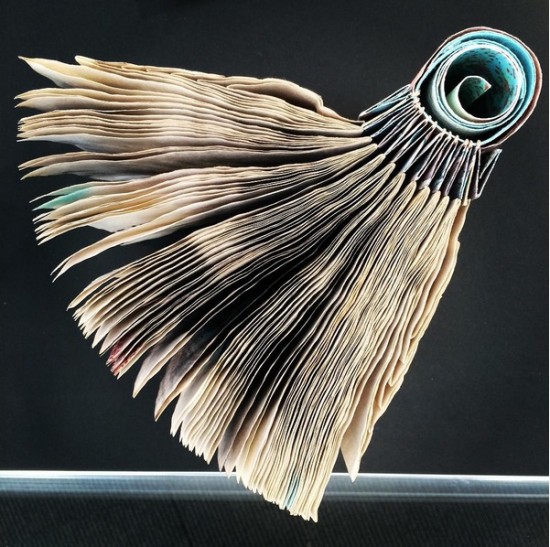
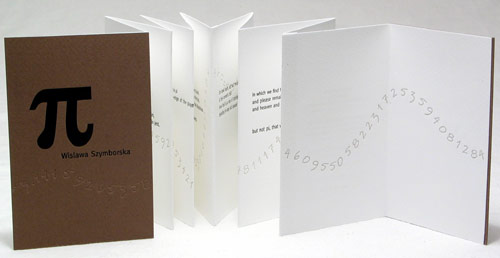
This week I read Olive Kitteridge by Elizabeth Strout. It’s a set of linked short stories, with the character of Olive Kitteridge, an older woman living in Maine, appearing, sometimes peripherally, in all of them. From the first chapter, I was struck by the stories the characters told themselves, about how they developed into their present selves and why. It was, for me, a sad book — Olive isn’t particularly nice or likable and the plots are usually about some sort of betrayal. But the writing is excellent and made me want to read on. As I’ve thought vaguely about storytelling throughout the week, I was taken with Radha Pandey’s post on the Bookbinding Etsy Street Team about the Katha-Peti (or story chest) from India. It’s a large and colorful artist’s book! Here are a few pictures below, but do look here to see many more, and a fuller explanation.
On one of the letterpress lists I read, someone asked for references for women working in the printing trade in 1879 St. Louis, MO, and doing “a menial job where she’ll get very inky through the course of her daily job.” There were quite a few answers, and one was from Richard Polinski, who referenced his blog post about the printing trade circa 1958. What interested me about the picture, and made me then read his post, were 2 things. First, when I got my press, my friend Eric told me it had probably been set up as those in the picture — by some sort of overhead pulley system that provided electricity. When I later tried to add a motor to my press, I found that I’d have to make quite a few modifications to accommodate one. Second, I was surprised to see so many women in the drawing, in the background. According to Polinski, they are feeding the presses. Read his entire post here.
Matt Robinson and Tom Wrigglesworth took “a selection of the most commonly used typefaces (to) compare how economical they are with the amount of ink which they use at the same point size. Large scale renditions of the typefaces were drawn out with ballpoint pens, allowing the remaining ink levels to display the ink efficiency of each typeface.” See them drawing here. (Found here.)
I’ve written about flexagons before — if you aren’t familiar with flexagons, they are flat “books” made from folded paper that are then unfolded, or flexed, to reveal a number of hidden faces. From my post, you can download a PDF on how to make them. They can be tricky to construct and tricky for the recipient to unfold-refold them. I ran across another similar structure, the infinity card which also folds and refolds but is far easier to design and construct. The video below shows how to make them. You can download Marilyn Scott Waters’ design to make your own at the bottom of this page. Waters also has a website with lots of free downloads of paper toys you can make.
In December my husband & I had dinner with my friend Hayden, who had recently been to Europe, and his wife Tracey. He told us about the chocolate initials he’d brought back for himself and Tracey, explaining that in the Netherlands, Santa Claus (known there as Sinterklaas) celebrated his birthday by handing out chocolate initials. I thought this was the perfect sort of thing for my blog. But when I went to research it online, I found nothing. Tracey couldn’t find anything either. We debated whether Hayden was just pulling our legs to see what we’d be gullible enough to believe (a thing he tries to do regularly). Then today I found this post (on the blog afterimage) that says
Rather than an orange at the toe of their stockings, St. Nicholas (known as Sinterklaas) brings good Dutch children their first initial, in chocolate form. Pastry and even sausage letters are also still available during Sinterklaas season.
The post points to another blog, called edible georgraphy, and this meandering but interesting post that starts out talking about miniature books and then segues into a discussion of edible letters. The photo above has the caption
Chocolate letter moulds. The letter I is unpopular with manufacturers as all chocolate letters have to weigh the same — those who do produce it often package two Is together. The letter M is the most popular — it is the first initial of moeder (mother) and mama. According to Droste, “Every year we keep track of how the different letters do. For example, two years ago we had too many Gs, so last year we adapted the production accordingly.”
The other day I followed a link to Philip Gallo’s blog and spent a wonderful hour reading the posts. Gallo is a letterpress printer and poet in Minneapolis. That’s his broadside to the left (see the post about it here — it’s about daffodils, printed on daffodil embellished paper, and with a subtle ff in the background). He doesn’t write often, and the posts vary widely, from writing poetry, to typesetting 40 years ago, to a poem called Imagine You Are A Craftsman to hand-setting mouse type. And a few of them are handy letterpress printing tricks: