Alpha Coffee Table
Saturday, September 6th, 2008
A wood type-inspired table from Crate and Barrel.
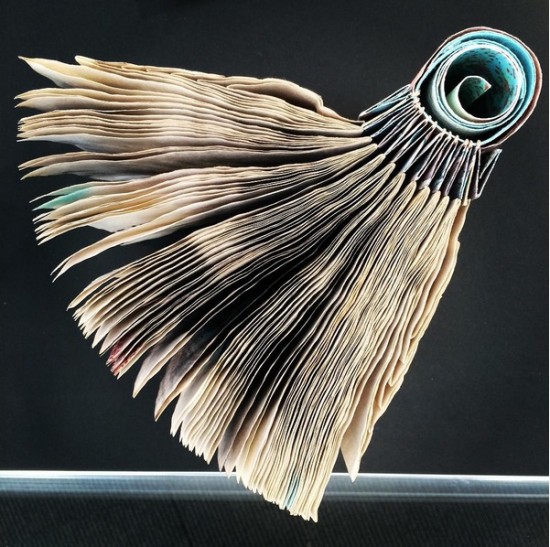
Palm leaf books are a traditional book form of Southeast Asia and India. They are long, narrow dried and painted palm leaves, strung together on a cord. Being vertical they are a nice alternative to the omnipresent horizontal accordion fold book. (The one to the right is from the Columbia University Library.)
I’ve been thinking about palm leaf books this week (and what I might do with the vertical format in general) after reading Holland Cotter’s NY Times review of an exhibit of one especially beautiful example in the exhibit Early Buddhist Manuscript Painting: The Palm-Leaf Tradition at the Metropolitan Museum of Art in NY. Cotter says “sturdy and compact, they weigh next to nothing. The collapsible format protects them from dirt and light … Such practical features — size, resilience, portability — help explain why … the illustrated book was popular in India between the 10th and 13th centuries. And they suggest why such books and their illustrations have survived into the present, while painting in more perishable media has not … The palm-leaf sheets varied in length, but were seldom more than a few inches wide. They were stacked like slats in Venetian blinds and bound by threads passed through two holes in the center of each sheet. Rather than forming a single surface, as in modern palm-leaf paintings, the sheets in books were meant to be seen one at a time. The sequence for viewing them was determined by the flow of an inscribed text, which was punctuated with tiny paintings.”
Several years ago, I made a book loosely based on the palm leaf (see it here). There’s instructions for making them here.
Carol Barton, author of the The Pocket Paper Engineer Volume 1 and Volume 2, has designed a pop-up card to celebrate the current (seemingly interminable) US political season… You can download and print a PDF that lets you choose your candidate and pop him right into the White House.
When I came home all excited about my laser cut pop-up book, my husband Harold wanted to know what else I could cut. He’s done a fair amount of woodworking, so I thought I’d cut letters or symbols out of some exotic woods and make pendants and then necklaces with suede or leather cord. Should be easy — right?
Of course nothing goes quite as planned! Harold cut the wood down and had a friend plane it to 3/16″ thick but then some of it (zebrawood) wouldn’t cut (it just burned up). Then I had to figure out how to make pendants — I haven’t made jewelry before with its new vocabulary (why are the little metal rings and bails and such called “findings”?). I found some tiny screw-in bails on-line and waited anxiously for them to arrive. Harold obligingly used his drill press to put teeny-tiny 1mm holes in the tops of the pendants. But the bails only came in silver which didn’t look right with the dark leather cord I had. Spray painting the bails black wouldn’t work, because the paint would just rub off right away. I inquired at the Tech Shop, where I’d used the laser cutter, if they had a powder coating set up (an electrostatic process that adheres power or dry paint to metal). They did, but there wasn’t a class scheduled, so in the meantime Harold found a heat-sensitive paint that fisherman use to paint patterns on their lures. I ordered the paint (and waited again for it to arrive).
To apply this paint, you heat the object with a propane torch then spray on the paint. In great anticipation I strung a few bails on a thin metal wire, heated them and sprayed. Oh no! The metal wire also got hot, and the paint adhered to the bail and the wire, fusing them together! Back to the computer to find heat-resistant (maybe Teflon?) wire. As I typed away at Google, Harold suggested I try using silver plated chain instead of leather and work on my chain-making skills (regardless of whether I used leather or silver chain, I was still going to have to attach a clasp). Certainly not rocket science, but would require some practice.
So that’s what I’ve done, used silver chain, leaving the powder coating lessons for another day. Below are pictures of the finished pendants. You can see more pictures by clicking on the image.

I’ve been asked several times about making flip books from a video. This tutorial gives templates for making your own using AfterEffects to turn the video into a series of jpegs that can be printed. He also talks about binding the pages and, in an ironic twist, made some movies to demonstrate his made-from-movies-then-printed flipbooks in action.
I’ve got a table in the “AltCraft” section of the American Craft Show in San Francisco next weekend (August 15-17). It’s by far the biggest fair I’ve participated in, and for the past several weeks my days have been full of bookmaking and printing and getting my table props ready. I really don’t know what to expect — my books and prints aren’t the usual wares at this show, but it’s juried, the “AltCraft” tables weren’t too expensive, and I applied because it looked like a good opportunity to introduce my things to another audience. Now I figure if I don’t sell much, I won’t have to make anything else for the upcoming holiday season! |
… or the OED in Limerick Form strives to have “least one limerick for each and every meaning of each and every word in the English language.” They have over 46,000 now, and are only up to Cz. Here’s a random one that was submitted for crabby (adj.)
The Abbot was crabby and cross;
He would soon show these monks who was boss.
“This manuscript’s hazy
And crabby—you’re lazy;
And blots mean half rations: your loss.”
Take a look (or even submit one) here.
Over the past year I’ve noticed that students in my letterpress classes invariably show up with the same small pocket-sized black notebooks. Some have been elaborately decorated on the covers. “Moleskine makes them,” one of my students told me. I noticed lots of people on Etsy selling them with artwork on the covers — usually Gocco printed. Moleskine encourages people to share the artwork in and on their products — the website has a section on an art show of work using Moleskines.
I bought one and they are really handy. Well made, they fit in my purse, have 64 pages (with the last 16 sheets perforated and detachable!) and the inside of the back cover has a bonus pocket for notes or clippings. I also tried printing a wood type collage on the cover (see photo above — I have them for sale on my website here.
But some of the best covers have been laser engraved (probably using the same sort of machine I used to cut out my recent pop-up book — the laser cutter can also engrave on glass and acrylic and thick paper). Below are two covers done by Modofly. They are bigger than the small pocket ones I’ve got. For more covers, see this flicker pool or this Etsy search.

One of my favorite afternoon activities is shopping for paper. San Francisco has a wealth of shops to choose from:
Arch (which is conveniently near the San Francisco Center for the Book) is a great source for paper as well as binding supplies. And it’s fun to browse their paper products such as cards and coasters. 99 Missouri Street, 415.433.2724.
Whenever I walk into the huge paper room at Flax, I think I’ve died and gone to heaven. From fine art printmaking paper to Japanese chiyogami to decorative wrapping paper to handmade paper with flower inclusions, they seem to have any kind of paper you’d ever want. Like Arch, they also have finished paper products to browse, as well as lots of ribbon. 1699 Market Street, 415.552.2355
In the Cow Hollow district, there’s Kozo Arts, with an extensive selection of Japanese and handmade papers. They also have book cloth and they specialize in custom boxes, photo albums, guest books and journals. (Be sure to walk down Union Street, and check out the other shops too.) 1969A Union Street, 415.351.2114
Paper Source has 2 locations in SF, on popular shopping streets: 2061 Chestnut St, 415.614.1585 and 1925 Fillmore St, 415.409.7710
For all things origami, try The Paper Tree in Japantown. 743 Buchanan Mall, 415.921.7100
If you visit Chinatown be sure to look for Joss paper. It’s an Asian paper traditionally used in burnt offerings at funerals and generally decorated with vivid gold and silver foil as well as saffron colored printing. It’s used by many collage and book artists. You can get it in most variety stores in Chinatown.
The Spring 2008 issue of Ampersand (the book arts journal I edit) is just out. In this issue, Charles Brownson, a retired librarian who often comments on the book arts list, contributes an article about what information to include in artists’ book colophons and Sarah Feingold, the lawyer for Etsy, helps demystifies copyright permission, in particular can you use the illustrations from an old book in your own artwork.
If I had to pick a favorite article in this issue, I guess it would have to be Theresa Whitehall’s Broadsides: Interactive Literature, a layman’s history of broadsides. She talks about a well-known local (San Francisco) printer, Jane Grabhorn, who was quite eccentric and practiced “her own brand of typography which was irreverent, humorous and cranky, by all accounts. For a while she promoted the idea that hyphens at the ends of lines were ludicrous. A word that needed to be split should simply break and begin again on the next line.”
You can see a list of all the articles in this issue here as well as order a copy.
Green Chair Press Blog is powered by
WordPress
Entries (RSS)
and Comments (RSS).